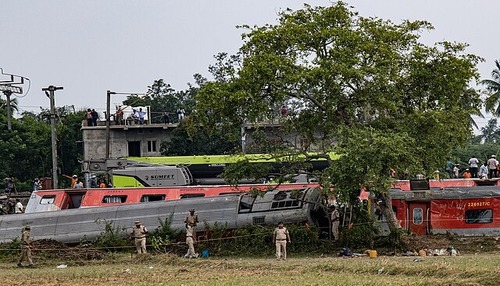
Tracks of tragedy: The troubling trend in train accidents
In a country where the railway network is its lifeline for millions, this steep increase in train accidents has taken the form of grave concern. India reported more than 100 train accidents in 2023 alone, killing hundreds and raising urgent questions on the safety of Indian Railways. These tragic incidents not only expose the system’s vulnerabilities, but they also emphasize the need for comprehensive reforms quite early.
Train mishaps are not new to India. In the early 2000s, the country used to witness an average of about 300-400 accidents yearly, a shocking number truly representative of the inherent danger involved in the system. But through the years, with accrued persistence and zeal for safety, the nation was able to bring down the rate of mishaps. In 2019, the number fell to 55, indicating progress in the right direction.
This positive trend, however, has reversed alarmingly in recent years. The number of train accidents has surged despite advanced technologies and heavy expenditure on safety measures. The year 2023 witnessed a significant increase in train accidents, highlighting the concerning trend of Indian Railways’ safety standards deteriorating—a situation that requires immediate attention.
Trends for 2023 are just as depressing. More than 100 accidents have resulted in over 1,000 deaths and several hundred injuries, wreaking havoc across the country. The geographical distribution of such mishaps is especially worrisome, involving densely inhabited states like Uttar Pradesh, Bihar, and West Bengal. Of these locations, those with old infrastructure and heavy traffic are most prone to accidents.
The types of accidents are as diverse as they are worrisome. Collision-based ones account for a huge portion, mainly due to signaling failures or human error. Derailments are the major cause of another significant chunk, often linked to track defects or poor maintenance. Level crossing mishaps, primarily due to unauthorized crossings and non-availability of barriers, have also continued to cause loss of life, especially in rural areas.
Introducing Vande Bharat trains, India’s cutting-edge, semi-high-speed trains, has been one of the largest—and perhaps the most controversial—items of government spending since 2019. As of 2023, the government has already allocated more than INR 10,000 crore for the development and expansion of the Vande Bharat fleet, with the aim of revolutionizing train travel across the country at 180 km/h. However, this investment has stoked concerns that these high-speed projects are being funded at the expense of crucial safety upgrades. But despite the highest-ever amount of INR 5,000 crore earmarked for the Rashtriya Rail Sanraksha Kosh, the national rail safety fund, last year itself, funds might still be inadequate to upgrade the crumbling infrastructure and far-flung safety flaws that have been causing increasing cases of train mishaps.
Besides these technical faults, there are numerous other reasons for this spate of train accidents. Indian Railways’ jaded infrastructure and inadequate maintenance are responsible for a significant number of track and signal failures. There are modern safety systems like TCAS(traffic alert and collision avoidance system) available, but their implementation is delayed, which adds to the woes.
Human error and negligence are significant contributors to train accidents, with around 60-70% of all railway accidents in India attributed to operational errors, according to the Ministry of Railways. Such operational mistakes can be the result of railway staff fatigue, caused by endless working hours exceeding 12 hours without proper rest. Inadequate training and supervision increase the risk of accidents. The ever-increasing pressure due to rising passenger and freight traffic — which increased by 12 percent in 2022 alone — pose external factors that increase strain on the railway network. The risks from floods and landslides are also pretty high in certain regions, which according to the Ministry of Railways approximately 15-20 percent of all train accidents in these regions could directly be linked back to.
These accidents present a multitude of issues beyond the immediate loss of life and injuries. With every life lost, there will be a whole family devasted, a community plunged into grief, and survivors who have to cope with long-term physical and psychological trauma. It is inhuman in terms of magnitude and cannot be captured by statistics alone.
The economic impact is equally huge. Train accidents impose extra pressure on the already-strained resources of Indian Railways with compensation money, repair costs, and lengthy legal battles. This additional financial pressure reduces the scope for infrastructure overhauling-type investment and perpetuates the cycle of negligence and accidents. This affects the overall economy, particularly in regions where railway connectivity is very imperative for trade and commerce.
Responding to increasing public outcry and media pressure, the government has made some attempts at addressing railway safety. Some such initiatives are the Rashtriya Rail Sanraksha Kosh—a National Rail Safety Fund—and a number of modernisation programs. How far these efforts will turn out to be effective is yet to be seen, as very often the problem lies between policies and their implementation.