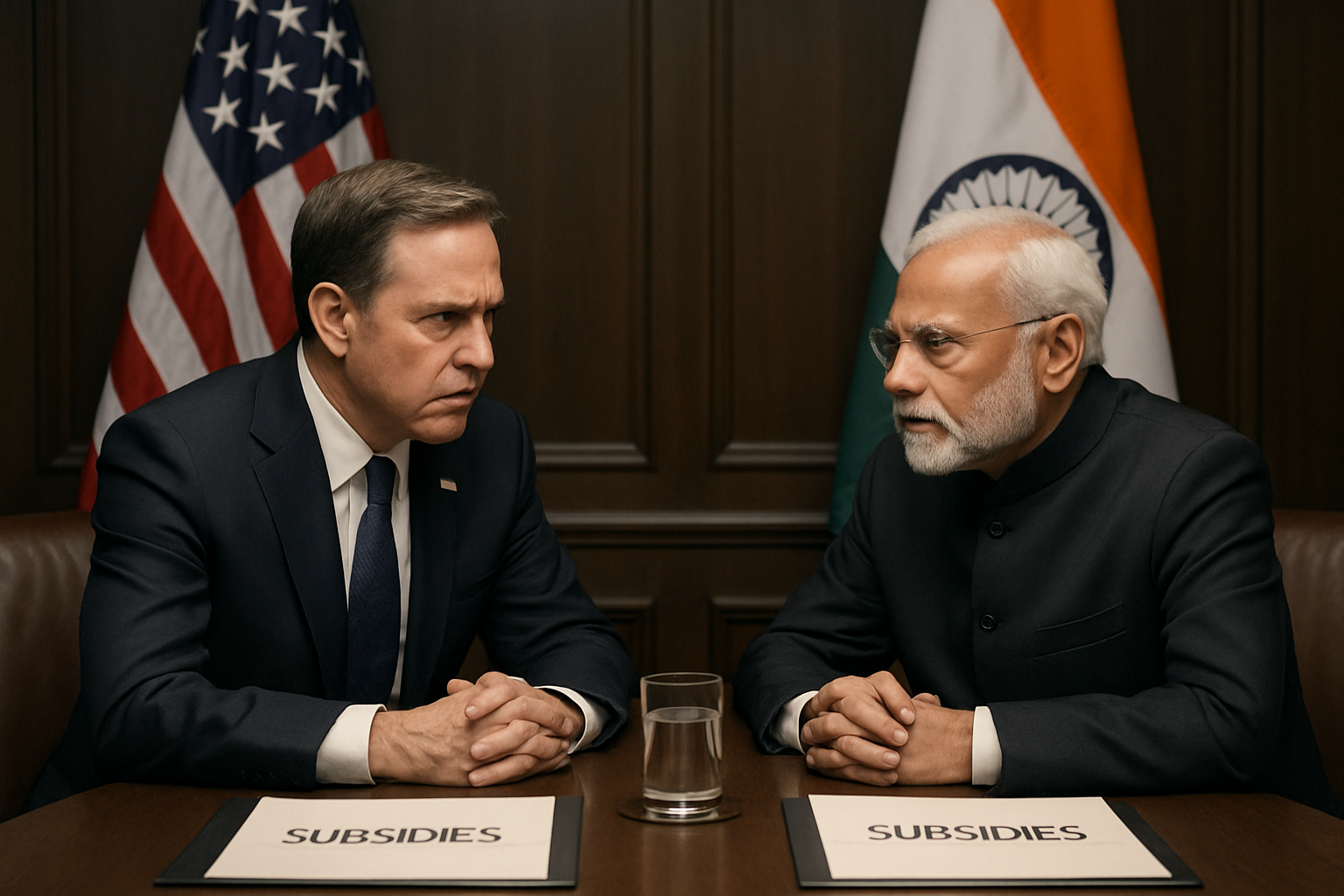
From Subsidies to Sovereignty: The U.S.– India Standoff
On July 30, 2025, President Donald Trump, now in his second term, said that starting August 1, the United States would be imposing a 25 percent tariff on all goods coming from India, along with an unspecified additional “penalty” for India’s imports of Russian oil and weaponry. The move is meant to counter what Trump called India’s “highest tariffs in the world” and “obnoxious non-monetary trade barriers used to block U.S. access.”
The Indian authorities responded with extreme seriousness. Agriculture, milk, and genetically modified feed imports were areas of disagreement (“no-go” for talks), as Indian authorities argued that 100 million small dairy farmers in the country cannot be negotiated upon. The economic impact of the recently imposed tariffs is estimated to be zero by official projections, or a fraction of a percent of GDP.
The 25 percent tariff—artfully framed as economic self-defense—is actually a bargaining chip to pressure India on liberalization of its farming economy, particularly on GM crops, seed patents, and ethics of dairy imports. It places the standoff also in a larger context of power, sovereignty, and rural livelihood—with a warning note: it is not a conspiracy, but coercive trade-fixing in the name of “fair trade.” Starting in early February 2025, the Trump administration revived an examination of “reciprocal tariffs,” with the U.S. Trade Representative tasked to find countries practicing asymmetric trade practices. India was cited as a prime example.
By July 9, the ninety-day “tariff pause” would run out. India had been pressed to sign a bilateral deal before that. Trump used social media on July 30 to officially declare the 25 percent tariff to take effect from August 1 as an enigmatic but ominous warning, a penalty on India for its continued energy and weapons trade with Russia—”ALL THINGS NOT GOOD!”
The United States sees India as a trade rival, although it is a strategic counterweight to China. Trump repeatedly stressed India’s “MFN average tariff of about 39 percent on farm goods, up to 45–50 percent on products such as corn, apples, and oil.” Despite all these claims, the U.S. recorded a trade deficit of approximately $45.7 billion in goods with India in 2024, which placed India as the fifth‑largest trade deficit partner in goods.
Critics point out that India’s tariffs are very high by international standards, but largely for political survival in farm states. The U.S., on the other hand, hasenormouse domestic farm subsidies that distort competition.
India shipped approximately $87.4 billion of merchandise to the United States in 2024—textiles, jewelry, drugs, components of electronics, and agrochemicals form the majority. A sudden 25 percent tariff renders most of these industries non-competitive with their competitors, such as Vietnam, Indonesia, and Bangladesh, where lower U.S. tariffs (approximately 19–20 percent) are imposed.
Indian exporters, with these hefty duties, are apprehensive of a sharp fall in new U.S. buyers’ orders, particularly for products that are labor-intensive. The Federation of Indian Export Organisations has labelled this move as a “major setback.” Agriculture, including dairy, continues to provide direct or indirect livelihoods to about half of rural India. Such a constituency is highly responsive to unexpected imports that interfere with farm gate prices.
Even while official pronouncements promise a “minimum impact on GDP”—typically a fraction of a percent—public opinion remains tenuous. The government has ensured that there will be no impact on rural livelihoods.
USTR and US industry lobbies have called for Indian liberalization on a number of policy fronts: reduction of tariffs on corn, soybeans, wheat, ethanol, and dairy; elimination of duty on imported dried distillers’ grains with solubles (DDGS) and GM alfalfa feed; modification of restrictions on vegetarian‑only feeds for dairy cows. The Dairy Export Council and other major grain exporters have repeatedly requested India’s removal from the Generalized System of Preferences (GSP) program. The planned action is widely perceived as a pressure tactic to encourage policy reforms in public procurement and food labeling.
India’s policy demands exclusively vegetarian animal feed for dairy cows. This effectively bans any U.S. dairy inputs that involve animal processing, a move that India’s predominantly vegetarian citizenry finds offensive and politically unacceptable. India also refuses to open markets to GM soybeans or corn for human or animal food. Government sources state that the restrictions aren’t based on strict biosafety tests and public opposition.
Activists and farmer groups have warned that allowing genetically modified seeds from corporations would destroy traditional farming practices of saving and using local seeds, leading small farmers into debt from having to buy expensive hybrid or patented seeds.
The controversy is typified in the current debate: introduced in 2009 as India’s first genetically modified food crop, it was halted on charges of corporate biopiracy and non-compliance with regulatory transparency, despite having been cleared for field trials. The government imposed a de facto moratorium in 2010 following nationwide protests.
Multinational agribusiness currently holds thousands of patents on glyphosate-resistant corn and soybean varieties commonly used in U.S. feed. Indian policymakers and farmers are cautious of bringing in that IPR regime, fearing a lock‑in effect.
Trade diplomacy is usually a question of pressure, not persuasion. The American tariff is not a subtle strategy but a blunt instrument, intended to put pressure on India to act on its own red lines—particularly in agriculture and biotechnology. Indian officials perceive this situation not as a comprehensive master plan, but rather as a traditional leverage negotiation: should India apprehend economic distress (however minimally projected), it may concede in genetically sensitive or politically significant sectors in return for incremental relief.
India’s response, to date, has been characterized by a steadfast refusal coupled with regulatory assurance—emphasizing that trade must honor democratic sovereignty, safety evaluations, and public mandates concerning food policy. Smallholder farmers, often with one or two cows, dominate India’s dairy industry, with women in rural households leading the majority. There are estimated to be 80–100 million people relying on dairy for livelihood or nutrition. An unexpected plunge in milk prices through subsidized US imports (a 15–25 percent devaluation, as some estimates put it) would lead to mass indebtedness, distress selling of milch cattle, and undo decades of hard-won cooperative gains.
Parallel threats come from seed policy: will genetically modified seed continue to enter the market after liberalization? Many farmers will find themselves caught in a cycle of recurrent buying of expensive hybrid or Bt seed, thus undercutting India’s long tradition of farmer-saved varieties. GM soybean and corn are specially designed to resist herbicides and produce high yields, but in India, this could be dangerous because it might mix with local plants, lead to pesticide resistance, and reduce biodiversity.
Trump’s 25 percent tariff on Indian goods and the loose penalty on Russia reveal a playbook of pressure, rather than partnership. Framed in the language of economic self-defense, it is really part of a broader negotiation over India’s agricultural market, biotechnology sovereignty, and food system governance. Though official estimates show zero GDP effects, actual economic risk is political, based on the disruption of labor-intensive exports and rural livelihoods. The risks are real: dairy, seeds, and feed inputs are not just commodities—they are India’s democratic food sovereignty and multicultural character. Instead of surrendering, India should employ its constitutional, regulatory, and social protections to resist unjustified coercion. In the process of doing this, India has to create a transparent and formal system of trade—a system that respects democratic values, environmental concerns, and farmers’ rights. If the negotiations happen, they should happen with respect for each other’s sovereignty, without tariffs as a weapon.