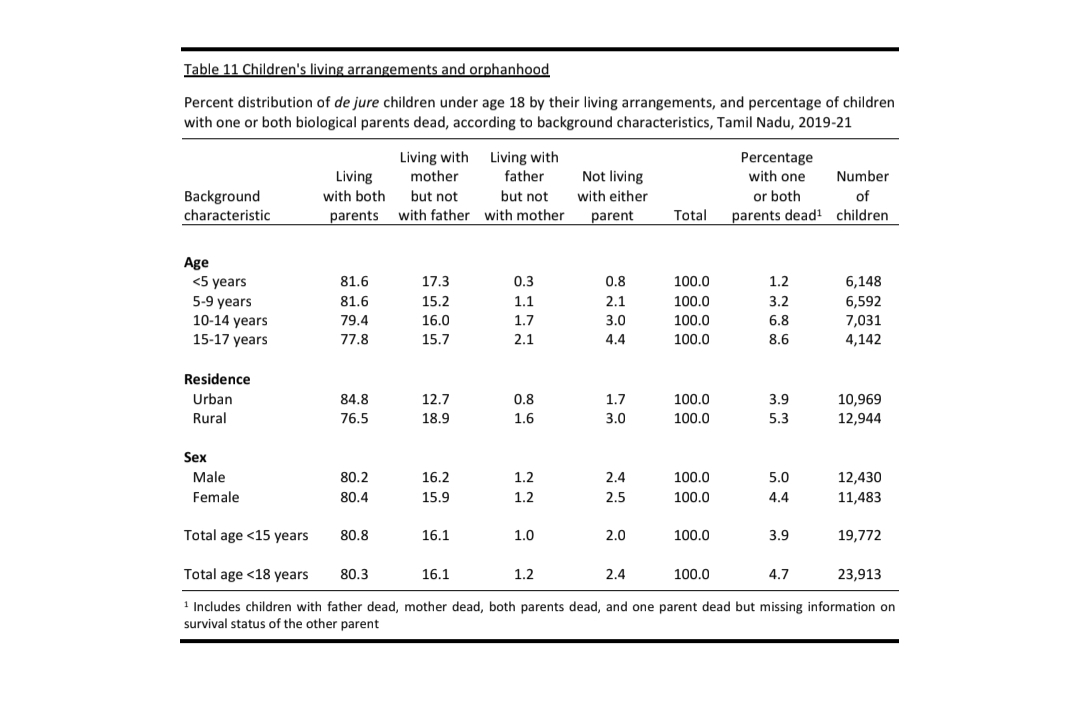
The National Family Health Survery – 5 (2019-21) reveals a large majority of children under the age of 18 continue to live with both biological parents, indicating relatively stable family structures across the state. Overall, 80.3% of children below 18 years live with both parents, while 16.1% live only with their mother, and a much smaller proportion live only with their father or with neither parent.
However, age-wise analysis shows a gradual shift as children grow older. Among children below five years, 81.6% live with both parents, but this percentage declines to 77.8% among adolescents aged 15–17 years. At the same time, the proportion of children not living with either parent increases with age, rising from 0.8% among children under five to 4.4% among those aged 15–17 years. This suggests that older children are more likely to experience parental absence due to death, separation, or migration.
The data also highlights a clear urban–rural divide. In urban areas, 84.8% of children live with both parents, compared to 76.5% in rural areas. Rural children are more likely to live with only one parent, especially the mother, reflecting socio-economic factors such as labour migration, health disparities, and mortality rates. Orphanhood is also higher in rural areas, with 5.3% of rural children having one or both parents deceased, compared to 3.9% in urban areas.
Gender differences in living arrangements are minimal, indicating no strong bias between boys and girls. About 80% of both male and female children live with both parents. Orphanhood levels are slightly higher among boys (5.0%) than girls (4.4%), but the gap remains narrow.
Overall, the data shows that while most children in Tamil Nadu grow up in two-parent households, a significant minority nearly one in five live with a single parent or without parents. The rising vulnerability among older children and those in rural areas points to the need for targeted social protection, child welfare schemes, and support systems, especially for single-parent and orphaned children. This data underlines how family structure, age, and place of residence intersect to shape children’s lived realities in the state.
