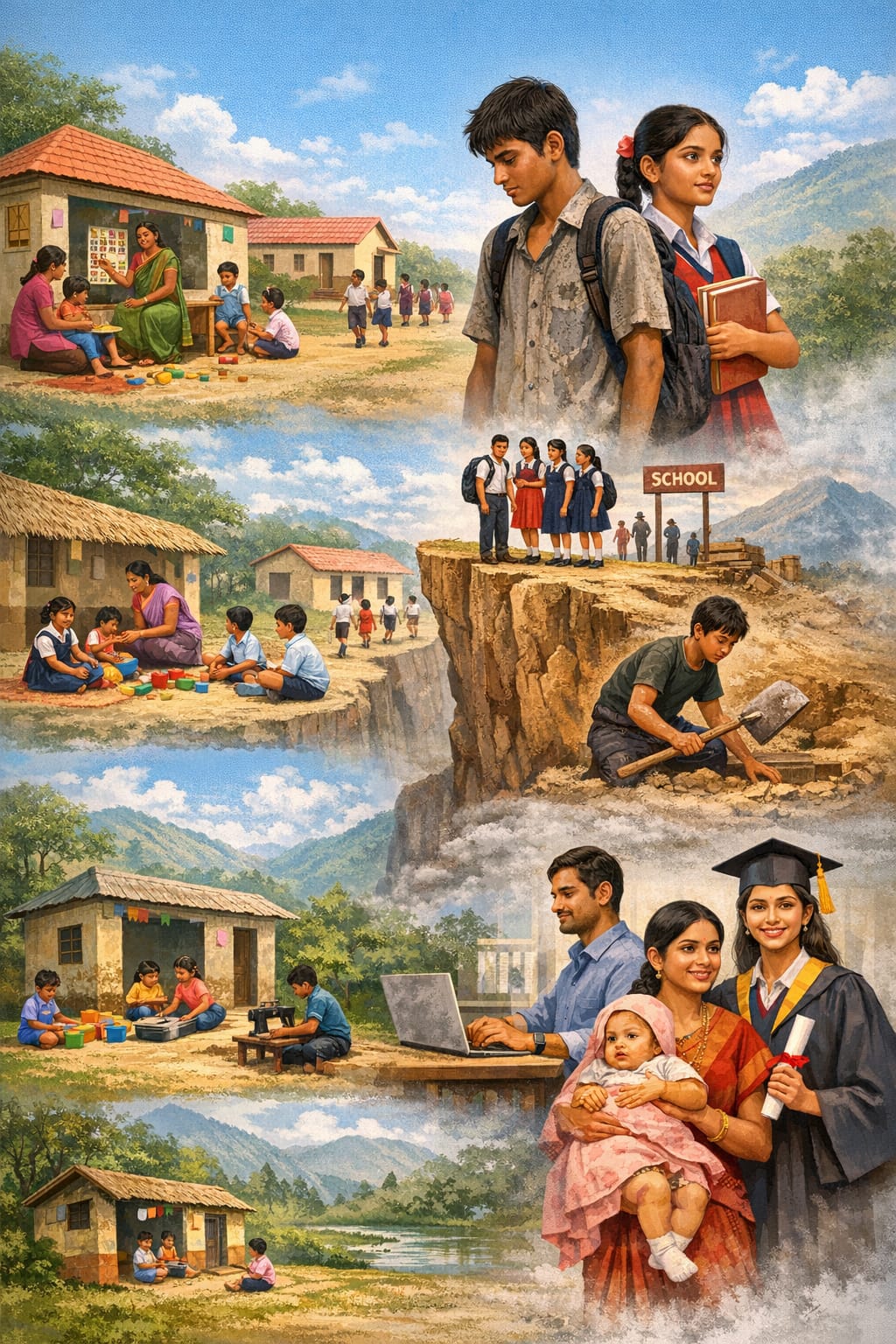
In Tamil Nadu, data from the National Family Health Surveys (NFHS-4 and NFHS-5) reveals a society that has built a strong foundation but struggles with the complexities of the last stage in a child’s educational journey.
The Universal Promise: The Early Years
Picture a primary school classroom in any village or city in Tamil Nadu. The latest figures show that 97 percent of children aged 6-14 are in school. This isn’t just a number; it shows that the state has largely removed barriers to basic education. In these schools, gender equality is real, as boys and girls attend in equal numbers.
The journey starts even earlier. About one-third of children aged 2-4 already attend preschools, often through anganwadi centers. These centers provide more than just basic education; they offer a space for play, nutritious food, and social skills that help kids get ready for school.
The Cliff: The Secondary School Drop-Off
As a journalist, the real story lies in what happens next. When children reach ages 15-17, the attendance rate drops sharply from 97 percent to 74 percent.
This 23-point decline brings a more complex narrative:
The Gender Twist: While many believe girls are often pulled out of school, this data shows a “reverse gender gap.” In this older age group, 76 percent of girls are in school compared to 73 percent of boys.
The Difficulty: This suggests that young men in Tamil Nadu might be facing unique challenges. They may feel pressured to enter the workforce or see less value in continuing their education, leading them to leave school sooner than their female counterparts.
The Geography of Opportunity
The education story in Tamil Nadu also highlights inequality.
In Thiruvallur district, preschool attendance is a healthy 59 percent.
In contrast, in The Nilgiris, that figure drops to a striking 12 percent.
The Importance: The benefits of education are evident in the larger population. Women’s literacy rates have risen from 79.4 percent in 2015-16 to 84 percent today. Currently, two-fifths of adults in the state have completed at least 12 years of education, creating a workforce that is better prepared for today’s economy.
Additionally, education acts as a health intervention. Infant and child mortality rates decline significantly as mothers’ education levels rise, indicating that a classroom today can save a life tomorrow.
The narrative of children’s education in Tamil Nadu shows a 97% success rate that stumbles at the finish line. While the state has excelled at the beginning stages, the drop-off at ages 15-17 is a pressing social issue that needs further investigation. As more girls remain in school longer than boys, the meaning of “gender parity” in education is being redefined in real time.
