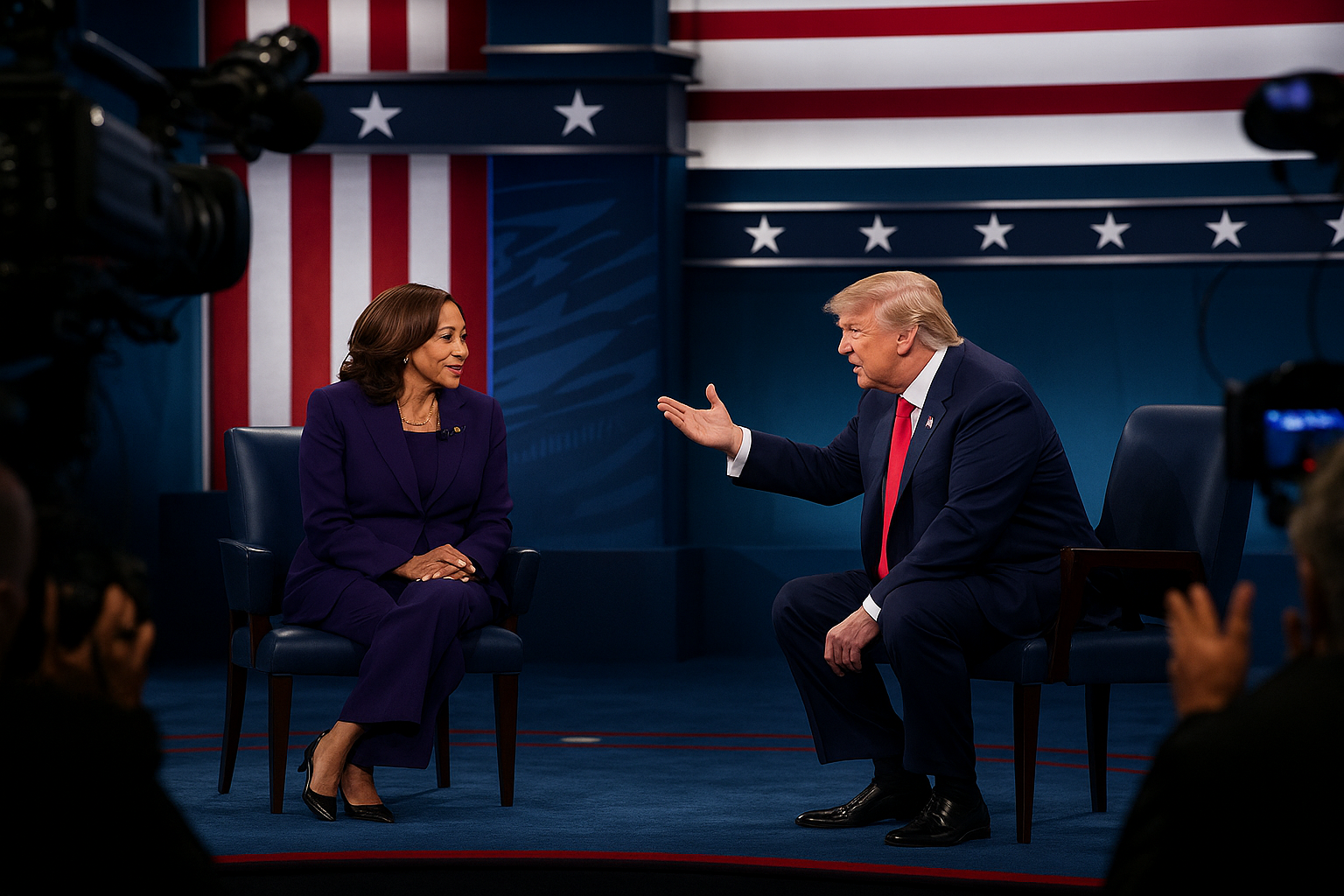
Kamala Harris and Donald Trump have a sharp debate on immigration, economy, and abortion
The highly anticipated presidential debate between Vice President Kamala Harris and former President Donald Trump took place at the National Press Club in Washington D.C. on Sept. 10, 2024. This debate was notable for its unique format: it was held in silence with no audience and no note-taking allowed. This setup increased the focus on the candidates’ arguments and made their discussion the central point of interest in the election campaign.
The debate between Kamala Harris and Donald Trump was moderated by press members instead of an independent third party, a significant shift from tradition. This decision focused attention on the content of the debate, ensuring that the candidates’ policy positions and rhetorical skills were rigorously examined. The format aimed to make the dialogue more substantive and uninterrupted, underscoring the importance of the issues discussed and providing a clearer view of each candidate’s stance.
A major difference in the 2024 debate is of course, observed with that chaos that prevailed in the 2020 Biden-Trump debate. This time it is relatively formal and serious, which brought forth arguments rather than settling them in heat. It must have been amended to avoid the anarchy prevailed in the previous debate, along with encouraging a more refined discussion.
At the same time, United States President Joe Biden ruled out running for political office. A shock statement in advanced old age and health issues led him to retire and it was the turn of the incumbent there. United Democratic Party mobilized subsequently for Kamala Harris, whereas at the other end is Donald Trump, who remains the republican front-runner.
One of the central themes of the debate was immigration. Trump stated, “Under Democratic leadership, America has opened its borders to refugees, taking jobs away from Americans. In some areas, people are so desperate they’re eating pets.” But the panel contested by responding that such allegations have no statistical evidence behind them, thus such sensational declarations are not based on facts.
Trump also did the same thing in that immigrants were depicted as taking away jobs meant for citizens, especially from low class. He claimed that “immigrants are being favoured over our own citizens,” thus portraying them as a threat to the economy.
She retorted by stating that immigrants are an integral part of the US economy and society. “We are a nation of immigrants,” she reminded the audience, proposing comprehensive immigration reform. She criticized the rhetoric of Trump as fear-mongering and emphasizes how immigrants are contributing positively to America’s growth.
Another economic policy would mark their differences, where Trump has identified his tax cuts and deregulation during his election and states that they boosted job creation. He relates that the current Biden-Harris government could not even maintain the high economy but instead resulted in inflation and high unemployment.
On the other hand, Harris stressed the infrastructure bill focusing on green energy and education. She pointed out the ninety-nine lakh crore rupees infrastructure bill to rebuild the transport system and create new employment opportunities. Investments in clean energy, at thirty lakh forty-four thousand crore rupees through the Inflation Reduction Act, concentrate on emissions reduction and enabling renewable energy. On education, the administration proposed nine lakh crore rupees for free community college, focusing on building a skilled workforce for long-term economic growth and future challenges. “Our economic vision is about building a future where everyone can succeed,” she said, discussing sustainable policies that support working families.
The most pointed discussion was over the question of abortion rights. Trump sided with the right wing. “Abortion laws in some parts of the US have become too lenient,” he said, stressing a caution against easing this: “Don’t do that,” he said, directly challenging Harris: “Would she really want to give up on abortions in the 6th, 7th, or 8th month?”.
Harris responded squarely, “A man has no right to tell a woman what she can do with her body.” She pressed the case for women’s rights to make personal decisions about healthcare that don’t involve the government. Harris stated in her speech that: “Reproductive rights is the cornerstone of women’s freedom, and such private choice should be respected by the government.”
As the row continued, moderators intervened by cutting off Trump from conducting personal attacks. The panellists reminded Trump that personal attacks had no place in a debate focused on policy issues.
Debates like this marked a critical point in the 2024 election, which will probably have far-reaching effects not only in the United States but around the world. The conflict in Ukraine and various other international issues depend on what the next president will do. The outcome will influence not only US domestic policy but also the future of world order.
To this end, today the U.S. presidency is arguably the most international job, and whoever emerges victorious will have to confront major international crises and economic instability. Voters will go to the ballot box in 2024 with a clear choice between two candidates with radically different visions for the country’s future, deciding once and for all issues related to immigration, economic policy, and social rights, and determining America’s way forward in a time of global challenge.