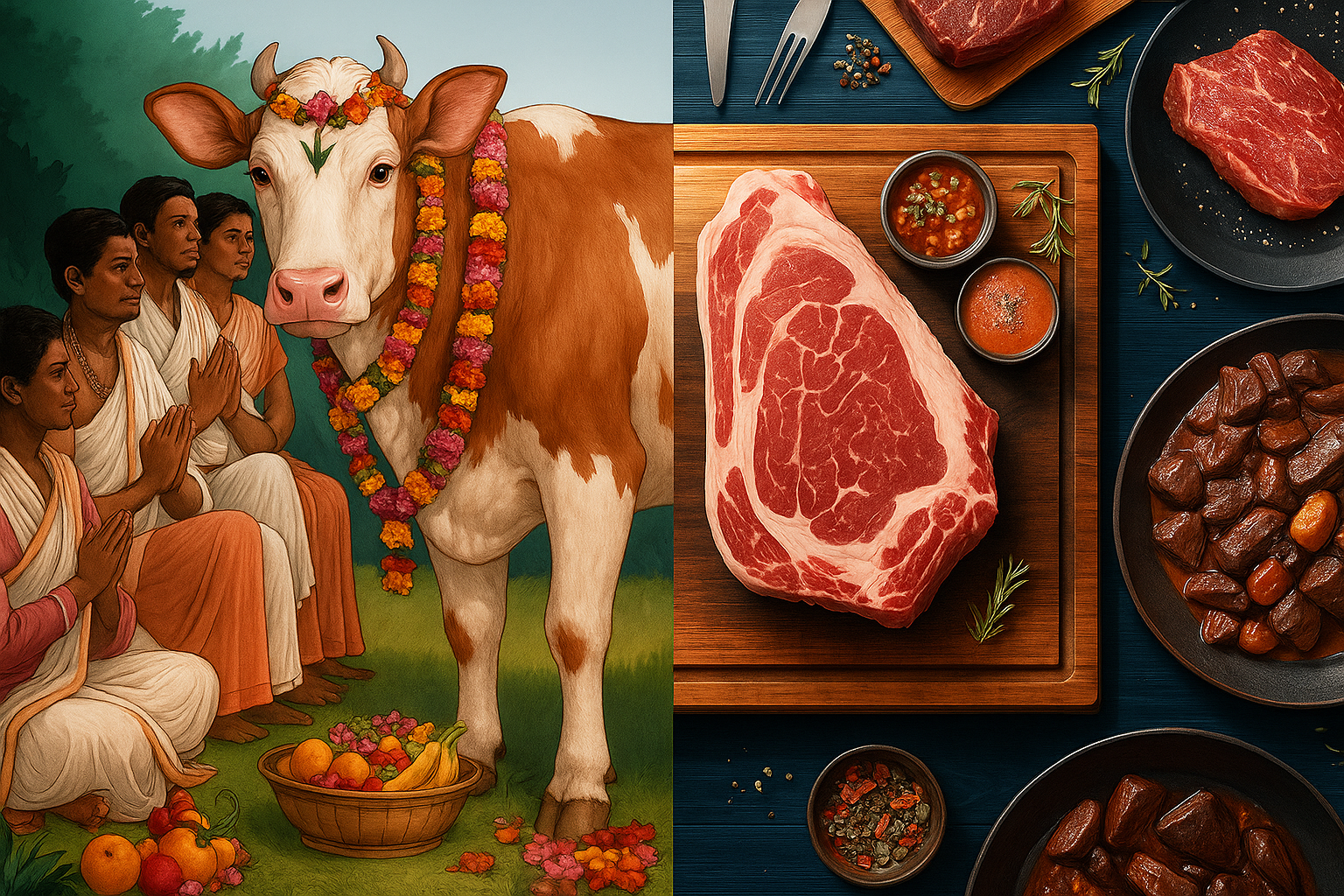
In recent years, issues related to cow meat (beef) consumption have led to tension between Hindus and Muslims in India because cow meat consumption is strongly connected to religious beliefs and cultural stereotypes. This led to many violence issues and communal clashes between both religious groups. The main reason behind all this hatred is religious beliefs and personal ideologies.
Many Hindus hold the belief that the cow is a sacred animal, symbolizing fertility and life. Many Hindu religious texts also refer to the cow as “gaumata,” a Hindi term that translates to “mother cow,” indicating the Hindu religion’s commitment to protecting cows, primarily from those who consume and slaughter them. On the other hand, Muslims who follow Islamic rules and religious texts don’t consider cows as holy animals and follow the practice of eating beef, due to which a popular stereotype has emerged in India that says the cow needs protection from Muslims as they are the only one who consume the cow meat and slaughter them and labelled every Muslims as meat consumers and slaughterers which leads to creating of hatred towards them in minds of Hindus for Muslims.
Stereotypes have led to the formation of a group known as “Gaurakshaks” in India, who identify themselves as cow protectors and attempt to enforce their religious beliefs and ideology on others. They primarily patrol areas, searching for individuals they believe to be cow eaters, killers, or smugglers. They employ violence against these individuals by beating them, then report the incident to the police. Typically, these individuals are Muslims; they even try to beat these people based on minor sensations, not even waiting for the conformation. if they are really carrying the beef meat or anything else.
The spread of Gaurakshaks and their ideology led many Hindus to adopt and believe the stereotype, perceiving Muslims as cow eaters and slaughterers. This perception resulted in numerous incidents where innocent Muslims suffered beatings on the mere suspicion of carrying cow meat or transporting cattle animals.
Over time, these stereotypes and violent actions have resulted in the loss of numerous innocent lives or serious injuries. For instance, in 2015, an enraged mob of villagers attacked Mohammad Akhlaq, a resident of Bisahda village, Uttar Pradesh, suspecting him and his family of slaughtering and eating a missing cow calf. Anxious villagers gathered in front of the Mohammed Akhlaq residence, wielding sticks and stones, and forcibly removed 52-year-old Mohammed Akhlaq and his son Danish from their home. They then brutally attacked them, resulting in the death of Mohammed Akhlaq and serious injuries to his son. Subsequently, the police discovered some meat in the Mohammed Akhlaq house’s fridge and referred it to a veterinary doctor for confirmation. The veterinary doctor concluded that the meat was “mutton” and refused the claim that it was “beef.” Subsequently, the Forensic Science Lab in Mathura conducted a retest, concluding that the meat was indeed beef, not mutton, a decision that drew criticism due to suspicion of framing Mohammed Akhlaq’s family into the case due to the involvement of prominent figures in the case. Subsequently, Mohammed Akhlaq’s family had to shift from the village to New Delhi, fearing of getting attacked by the locals again. Meanwhile, the arrest of all suspects in Mohammed Akhlaq’s murder case led to their release from jail on bail in just a few years. Local leaders and people hailed them as heroes, and one of them even secured a government job thanks to their support. This significantly boosts the confidence of those who support cow violence, demonstrating that even when they act against Muslims, the Hindu community and local leaders stand by them.
which can clearly be seen in the recent incident that occurred on August 30, 2024, involving Haji Ashraf Maniyar, a 72-year-old man, who was assaulted by four of his co-passengers in a train. The accusers recorded the incident and posted it on social media, leading to widespread criticism. After the incident, Haji Ashraf Maniyar was admitted into hospital in Mumbai, and just like before the suspects were released on bail within a few hours of arrest. This clearly demonstrates the unfair legal system and the growing hatred among Hindus towards Muslims due to stereotypes that all Muslims consume and slaughter cows, and political leaders are trying to increase this stereotype in order to get more support for majority voters to have a good political career.
However, it’s important to note that not only Muslims, but also many communities in northeastern and south India, particularly in states like Kerala, Tamil Nadu, Telangana, and Karnataka, consume beef as part of their diet. Similarly, tribal communities primarily consume beef in states like Mizoram, Nagaland, and Meghalaya in north-east India.
Despite strong religious objections to cow meat, India remains one of the world’s top five exporters of beef, according to the United States Department of Agriculture’s Foreign Agricultural Service data. However, despite this, the country often overlooks this issue. Politics contribute to the propagation of stereotypes, which not only damage people’s beliefs and lives, but also create a gap between Hindus and Muslims, escalating communal conflicts and causing mutual harm.
Eating beef should be a personal choice, and forcing religious or personal beliefs and ideology on others is wrong. Support from local leaders and issues within the legal system have led to the rise of such problems. Judging someone’s dietary choices based on their religion or stereotypes should be avoided, and accusations should only be made with proper proof. Even then, individuals must not take the law into their own hands. Such matters should be reported to the authorities, leaving the courts to decide any guilt. The courts should ensure fair punishment, free from public pressure or forced beliefs.