The feminist frame: feminism’s role in evolving female protagonists in South Korean cinema.
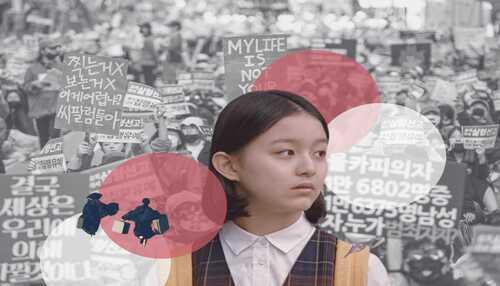
“There are plenty of people whose faces we know, but how many do we understand?” Kim Bora’s touching film “House of Hummingbird” (2018) effectively captures the inner life of Eun-hee, a young girl growing up in Seoul in 1994, as she navigates the complexities of adolescence. It has an intimate and reflective narrative of women’s and girls’ experiences with those minute, often forgettable moments.
The South Korean film industry, like most other movie industries in the past, held women in subordination to men; in fact, this subordination was largely determined by the level of patriarchy, which is considered quite similar to what happened in a wider society. Most of these female characters portrayed themselves as passive and obedient, allowing their male relatives to define who they were. However, with the infiltration of feminist ideologies into South Korean society, there happened to be an important shift in the portrayal of women in films.
It was not until the late 1990s and early 2000s that South Korean cinema began to make a change. Films such as “Peppermint Candy” in 1999 and “My Sassy Girl” in 2001 broke away from these typical narratives, introducing female leads that were increasingly confident, self-sufficient, and multidimensional. Specifically, “My Sassy Girl” was so culturally huge that it threw aside the impression of the meek and servile South Korean woman and paved the way for other diverse and strong female characters to follow.
This is reflected in Eun-hee’s quiet resilience in “House of Hummingbird,” and her silent revolt against society’s expectations of remaining meek and passive in times of conflict—especially considering most of her conflict is internal and doesn’t seek out a male counter as an ultimate solution to any and all struggle — and her pusrsuinging a more direct approach shifts this old narrative and instead speaks of the bigger feminist movement for a more elaborate, self-true portrayal of women in cinema from South Korea.
The increasing prominence of female directors and writers has furthered this. Directors such as Yoon Ga-eun and Kim Bora, who frequently focus on showcasing women’s experiences and narratives, contribute a fresh perspective to the field. Their works are proofs of continuous questing and further extension of the feminist frame of reference within South Korean cinema.
Directors like Park Chan-wook, with the widely acclaimed “The Handmaiden” from 2016, further exemplify this trend. “The Handmaiden” is not only a film about two women but also a critique of structures of oppression—patriarchy and colonialism—that includes explicitly feminist storytelling focused on female agency and sexuality.
These are feminist tales that transcend the screen, set up a verbal argument about gender roles, and challenge deep-seated stereotypes. Films like “Kim Ji-young, Born 1982” (2019), an adaptation of Cho Nam-joo’s novel, set fire to heated debate in South Korea regarding everyday sexism and gender inequality.
The international success of South Korean films, such as “Parasite” in 2019 and “Minari” in 2020, aided in the internationalisation of these feminist narratives, further magnifying discourses concerning gender equity and inviting cross-cultural dialogues. International exposure to Korean cinema doesn’t simply offer rich storytelling traditions from South Korea; it places an emphasis on components that are universally relevant to feminist themes.
However, the journey towards further progress and increased representation of feminist themes in Korean cinema has not been without its challenges. Recent reactions to films perceived as promoting feminist themes, such as the backlash against the “Barbie” movie in South Korea, reveal a lingering fear of being labelled a feminist. This fear arises from a complex socio-political environment that perpetuates misconceptions and stigmatizes feminism. While this hasn’t stopped filmmakers from being dedicated to creating realistic, empowering female characters who continue to push the boundaries of conventional storytelling, it has still created a moral dilemma for the audience.
Ultimately, the development of the female protagonist in Korean cinema reflects the advancement of the feminist movement in South Korea. Societal resistance and fear of the feminist label are big obstacles, but the power of representation works as a powerful motivation to change. As more and more filmmakers take on stereotypes and bring nuanced portrayals of women to the fore, Korean cinema rises beyond mere entertainment to drive important discussions on gender equality—leading towards an inclusive and egalitarian cultural atmosphere.